
Why Austin Is Especially Hard on Residential Ductwork
Austin is a wonderful place to live — but it is genuinely one of the more demanding climates in the country for HVAC systems and ductwork. Your air conditioner runs eight or more months a year. Attic temperatures routinely exceed 140°F in July and August. Cedar, oak, and grass pollen seasons push outdoor allergen levels to some of the highest in the United States. Humidity swings from bone-dry winters to swampy summer afternoons. And rapid growth across Travis County means a lot of construction dust and new homes with never-been-cleaned duct systems.
All of those factors combine to create ductwork problems that are faster, more severe, and more costly than in milder climates — and most Austin homeowners don't discover them until they're already paying the price in high electric bills, uneven temperatures, or worsening allergies.
Here's a close look at exactly how Austin's environment damages your duct system, and what Edwards Air Duct Cleaning recommends to protect your investment.
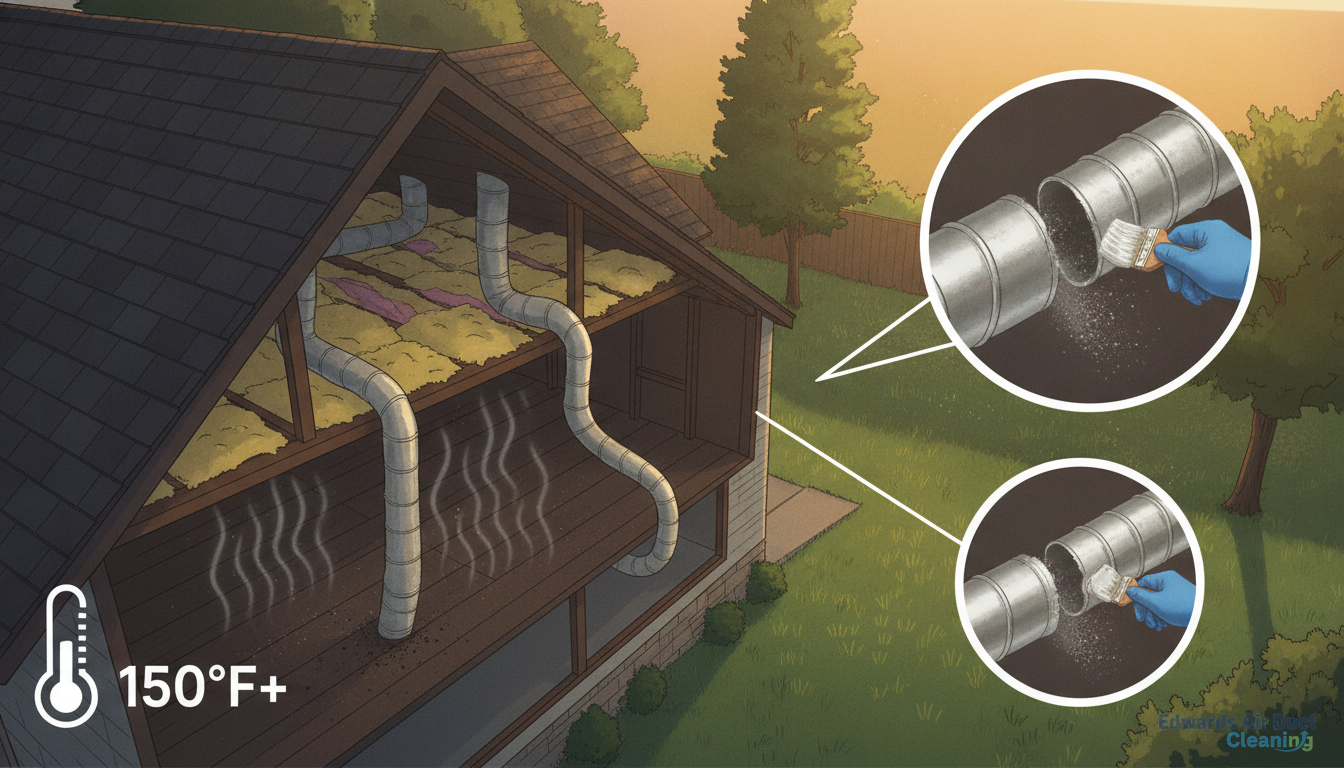
Extreme Attic Heat Degrades Flex Duct Faster Than You'd Expect
The majority of Austin homes built since the 1980s use flexible duct — a multi-layer construction of inner plastic liner, fiberglass insulation, and outer foil jacket — routed through attic spaces to supply conditioned air to every room. The problem is that flex duct is not designed to tolerate decades of 140°F attic summers.
Over time, the inner liner becomes brittle and develops small tears. The foil jacket cracks and separates at joints and bends. Insulation compresses and loses its R-value. And any section of flex duct that was installed with a sag or sharp bend — common in rushed new construction — becomes a restriction point that reduces airflow to that part of the house.
When joints disconnect even partially, your attic air — which contains fiberglass particles, rodent dander, insulation debris, and temperatures that can feel like a blast furnace — gets pulled directly into your living space through the return-air side of your system. Our duct repair and sealing service uses mastic sealant and UL 181-rated foil tape to address these failure points before they escalate into larger problems. Homeowners in established areas like Rollingwood and Tarrytown with older flex duct installations are particularly good candidates for a proactive inspection.
Cedar Pollen Season Loads Your Duct System Like Nowhere Else
Austin's mountain cedar (Ashe juniper) pollen season runs roughly from late November through February and produces some of the densest airborne pollen loads recorded anywhere in North America. Cedar fever — the itchy eyes, runny nose, fatigue, and sinus pressure it causes — is so common that Austin-area clinics see a dramatic spike in patients every January.
What many cedar fever sufferers don't realize is that even with windows closed, fine pollen particles infiltrate your home through HVAC system air intakes and gradually accumulate inside your ductwork. By the time spring oak season arrives and then summer grass pollen, your ducts have collected months of biological material that your system redistributes every time it cycles on.
A residential air duct cleaning in late winter or early spring — after cedar season peaks — removes that pollen accumulation before the long cooling season begins. Pairing the cleaning with a duct sanitizing treatment provides an additional layer of protection by eliminating mold spores and bacteria that hitchhike in on pollen and moisture.
Summer Humidity Creates Ideal Conditions for Mold Inside Your Air Handler
Austin's summer humidity — combined with the fact that your evaporator coil is constantly cycling between cold and ambient temperatures — creates a persistently moist environment inside your air handler cabinet. The coil fins, blower wheel, and condensate drain pan are all surfaces where mold, algae, and bacterial biofilm thrive in these conditions.
A clogged or slow-draining condensate line is one of the most common causes of water damage in Austin attic-mounted and closet-mounted air handlers. When the drain line backs up, the overflow pan fills and can release gallons of water into your ceiling, insulation, and framing before you notice any visible sign inside the living space.
Our air handler and coil cleaning service addresses every moisture-prone component — evaporator coil, blower wheel, drain pan, and condensate line — and applies an EPA-registered antimicrobial treatment to inhibit future biological growth. For Austin homeowners, scheduling this service every one to two years is one of the best investments in both HVAC efficiency and water damage prevention available. Customers in neighborhoods like Mueller and South Congress frequently combine this service with a full duct cleaning for a complete system refresh.
Construction and Renovation Contaminate New and Existing Duct Systems
Austin's growth has been extraordinary — and that means a significant share of homes across Travis County have either been recently built or recently renovated. Both scenarios introduce large quantities of fine drywall dust, concrete particles, wood fibers, and insulation fragments into the duct system.
During construction, HVAC registers are rarely sealed adequately, and the system is often run to control humidity during finishing work — pulling construction debris directly into the ductwork. A post-construction or post-renovation duct cleaning is strongly recommended before a family moves in or returns to the home, and it's a service we regularly perform for Austin builders, remodelers, and homeowners throughout the metro area.
Pest Activity: A Unique Austin Duct Hazard
Austin's mild winters and urban tree canopy support robust populations of squirrels, birds, and rodents that frequently find their way into attic spaces — and from there, into poorly sealed flex duct joints or damaged duct sections. Nesting material, droppings, and animal dander inside your ductwork create serious air quality issues and can partially or fully block individual duct branches.
During every duct cleaning, our technicians inspect for signs of pest intrusion and document any conditions that warrant attention. If we find evidence of nesting or entry points in the ductwork, we flag those areas for sealing as part of our duct repair and sealing service.
A Year-Round Protection Plan for Austin Homeowners
Given Austin's combination of climate stressors, we recommend the following maintenance schedule to keep your duct system performing at its best:
- Every 1–2 years: Air handler and coil cleaning to prevent mold, maintain efficiency, and protect against water damage
- Every 2–3 years: Full residential duct cleaning for homes with pets, allergy sufferers, or older HVAC systems
- Every 3–5 years: Full residential duct cleaning for newer homes with no special circumstances
- Annually: Dryer vent cleaning to prevent fire risk and maintain appliance efficiency
- As needed: Duct repair and sealing when inspection reveals leaks, disconnected joints, or damaged flex duct
- After cleaning: Duct sanitizing and deodorizing for homes with pets, smoke history, moisture issues, or musty odors
Edwards Air Duct Cleaning serves Austin homeowners across Travis County from Hyde Park to Rollingwood and everywhere in between. Our team is trained to identify the specific damage patterns that Austin's climate creates and address them with the right tools and techniques.
Call us at (737) 265-3222, email [email protected], or visit our office at 11673 Jollyville Rd, #206, Austin, TX 78759. We're available Mon–Sun, 8 AM–6 PM to schedule your inspection, cleaning, or repair estimate.